

What does 2pac have to do with Swiss philosopher and composer Jean-Jacques Rousseau? I have never heard Rousseau spitt’n bars over his compositions and for sure Tupac couldn’t have made his hip hop. So what then? Well, both men had a lot to say about society and human nature. This article is a continuation of the three part series on Plague, War and Famine, and the current one will be exploring War (‘rampage’) and of course what we can take from these two men on the issue. (If you missed the article on plague you can find it here.)
I am of the opinion that wars and perhaps all conflicts which involve groups of people, stem from tribalism.
By looking at this type of conflict on the simplest level, we can see two things; belligerents of course, and groups that identify with each other.
We all belong to, try to form, and maintain tribes. Be it a religion, denomination, political party, a certain school (of thought) et cetera, or the lack thereof. These are all forms of tribalism. The negative side of tribalism stems from our attempt to identify cooperative strangers from non-cooperative strangers. In order to do this, we use social indicators of shared values, for example: social rituals, language (or dialectal variation), clothes and so on. We can then see that, the same things we use to identify with members of our various groups, divides us from non-members. Now that the foundation is set, let’s move on to the bigger picture.
Rousseau and The State Of Nature
Man is born free and everywhere he is in chains
Rousseau, 1762
Rousseau argues that human beings derive their sense of self from the opinions of others. I would take that a step futher and say that, humans derive their sense of self from the opinions of members of their own tribes and (sometimes) tribes they aspire to be in. Either way, Rousseau sees this as ruinous to freedom and individual authenticity. He then progresses by saying modern man, is the victim of a divided subjectivity, (what I would call tribalism) and spreads disorder and unhappiness while convinced that he is acting in his own interests. This is congruent with what we see in all levels society today. Conflicting tribes usually squabble for the opportunity to be the dominant force while trying to downplay members of other tribes. All this, while not realizing that life isn’t a zero-sum game. By playing that way, the contradiction is this: cooperation leads to prosperity, while the opposite holds true. However, by cooperating with one group you automatically oppose another group and non-cooperation comes in the picture. This then, can result in chaos, and often times war. Let’s see what Tupac has to say.
Tupac on Society
I know that everyone in this [music] business keeps on whispering in the ear about what you can’t do, what you can’t say, what you can’t wear, in this world and in this world- it’s two worlds; a white world and black world. All I did was stand in the middle and say I’m living in both worlds.
Tupac Shakur, BET interview 1994
Here, Tupac implicitly affirms the existence of tribes; that he terms as ‘worlds’. However, instead of declaring his allegiance to any, he says that he is living in both. Of course though, this isn’t applicable to every situation. A matter of fact, assimilation is rarely ever encouraged since it is seen as oppression of individual authenticity as Rousseau puts it. Tupac has more to say though.
I’m tired of waiting for my pass to get to society. All I ever wanted was to make me and everyone around me more comfortable about where we were… this is our home base, let’s try to build it up instead of tryna assimilate and get a pass key to where they at.
Tupac Shakur, BET interview 1994
Again, his words reflect a ‘us vs them’ type of thinking. In truth, we are all different and I think we should embrace our differences, and have pride in them as Tupac was implying, but at the same time, respect the differences of others.
So how can we come to terms with out-group members?
Well, one way according to psychologist Joshua Greene is called manual thinking. This involves developing a common moral language. It means acknowledging that it is pointless to construct moral arguments that we wouldn’t accept from others. For example, if you aren’t concerned about supernatural threats of one group, don’t expect another group to be threatened or concerned about our own superstitions. Manual thinking also involves expanding/changing loyalties from simply tribal, to human. Here, justice can be aligned on all levels; individual, group and human. Conversely, when loyalty is tribal, the group is misaligned. The region where things don’t overlap is called hypocrisy. This is where one group exercises special treatment for itself and doesn’t extend that to other groups. Any act of shielding someone of your own ranks from a punishment that would be exerted on a member of another group is an example of this hypocrisy.
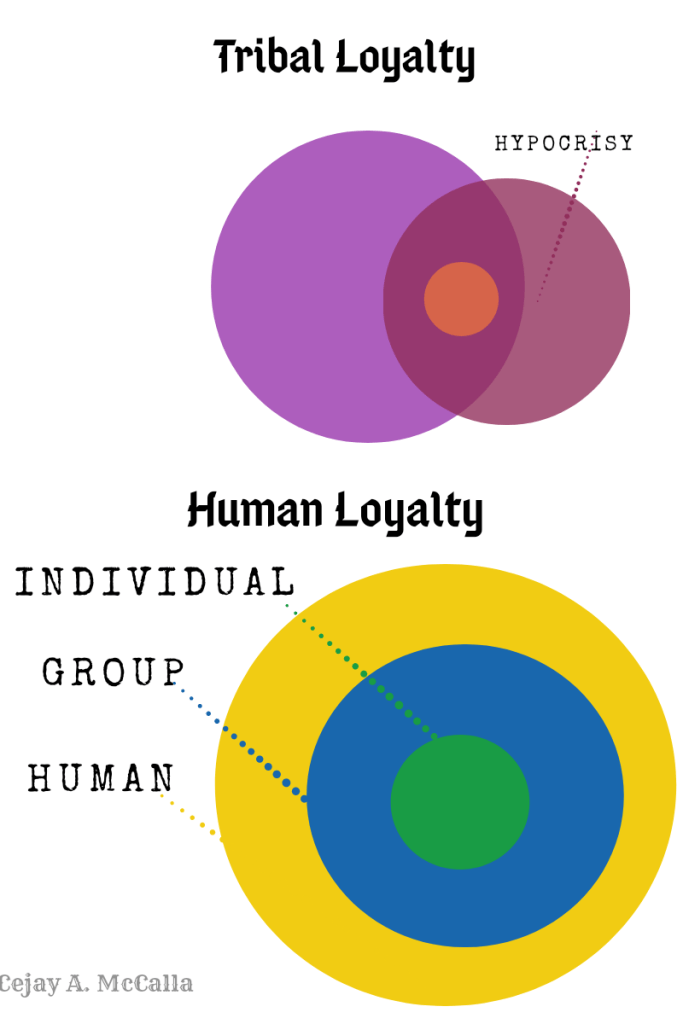
Manual thinking also involves trying to understand the stand point of other groups. This does not mean you are validating their claims.
All in all, manual thinking seems to be an escape route from tribalism. The opposite on the other hand, reflexive thinking (which is often flawed), results in chaos and war.
It takes skill to be real, it’s time to heal each other.
Tupac Shakur
You heard the man, despite your clan, we are all one. Corny, but look out for your fellow human.
 TechnoNovus